The Future Networks Forum (FNF) identifies opportunities where lines companies can align to help Aotearoa reach our climate change goals and create value for customers. Below is a short summary of the initiatives currently being worked on.
The FNF is co-chaired by James Tipping from Vector and Andrew Kerr from Alpine and the group is made up of representatives from across 25 lines companies.
New members are encouraged to join the Future Networks Forum so we can form a comprehensive view across all lines companies. If you’re from a lines company, and you want to find out more, please email us at FNF@electricity.org.nz.
ENA members can login to the full FNF pages, which include reports and resources, here.
If you’d like to hear more about the FNF – or a particular project – email FNF@electricity.org.nz.
Aligning EDB capability, roles and functions to enable distributed flexibility
We’re starting to see more and more distributed energy resources (DER), like solar panels and battery systems, in Aotearoa. As these numbers grow, lines companies will need to plan and operate their networks differently. They will need new capabilities to ensure DER are managed in a smart and flexible way – including shared control of hot water.
If we get this right, it will not only benefit consumers who own the DER, but all electricity consumers as they won’t have to pay for the lines companies to build as much additional capacity into the network.
Several lines companies in Aotearoa have piloted solutions for how to manage DER in a flexible way. And some countries, like Australia and the UK, have a lot of insights that we can borrow about how to leverage DER for operational efficiency and building more reliance into the electricity system.
A project within ENA's Future Network Forum has paired international research with significant engagement with our domestic lines companies to determine what new capability, roles, functions we need to enable flexibility here in Aotearoa.
In September 2024, we ran two webinars, one for EDBs and one for external stakeholders. You can see the presentation and the poll results from our external webinar.
Stage two of this FNF project was about evaluating the industry architecture and models for distribution system operation (DSO) to fulfil the roles and functions. It sets out possible paths for how DSO could evolve here in Aotearoa and raises the key questions we’ll all need to grapple with as DER (like EV chargers, batteries and solar) continue to take off. The final report was made publicly available in May 2025. You can find it here: Potential DSO models for Aotearoa.
Customer segmentation
This project helps to underpin all wider FNF projects. It’s about building a shared understanding and common language amongst lines companies about who our customers are, their current and future needs, and the pain points in their customer journeys – which lines companies may be well-placed to address. This is a core foundational piece, and will ensure a customer-centric approach to FNF’s ongoing prioritisation and work programme. This project did a deep dive into large DG customers and charge point operators. The findings were used to come up with solutions to improve the connections journey.
In December 2025, we released a national residential customer segmentation model for Aotearoa New Zealand. The model combines actual electricity usage data from participating lines companies with 2023 Census data to create a consistent, nationwide picture of how different households use electricity, their ability to pay, and their likely needs. This work also overlays research exploring attitudes related to affordability, energy-saving behaviour, solar, EVs and home energy management systems. View the research here: Electricity customer segments by location and household type
Connections journey mapping
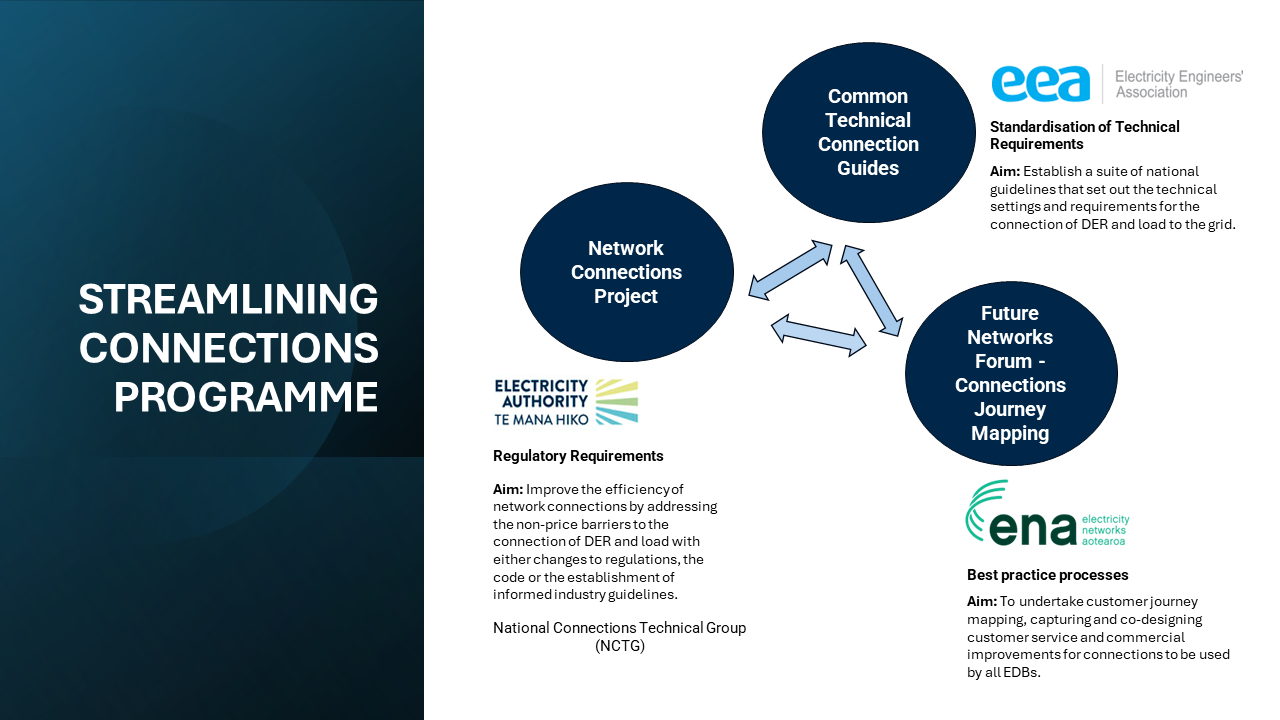
The need for high-speed public EV charging stations, together with the growth of applications to connect distributed generation, is one of the reasons that this project is so important. The FNF ‘Connections Journey Mapping’ project is about aligning EDBs’ processes to improve the connections journey for customers.
The project members are working closely with the Electricity Engineers’ Association and the Electricity Authority (who are also doing work in this space) to ensure that the projects align nicely so we can create real improvements in the customer connections journey.
The project team has engaged with charge point operators, large distributed generation customers and lines companies to fully understand their pain points and discuss potential solutions. As a result of this engagement, the team has come up with a long-list of 13 action points to improve the customer journey, from pre-application right through to delivery. The team believes these will also benefit other connections stakeholders following feedback EDBs have received.
The first six ‘quick win’ solutions have been developed, and shared with all lines companies so that they can be adopted. These first six outputs are:
- connections self-serve manual
- connection FAQs
- connections introduction guide
- connection journey steps
- pre-application EDB manual and pre-application customer template
- glossary (link to ENA website, also linked in implementation instructions)
The project team are now starting to work on the next three outputs. These are:
- working with Simpson Grierson to standardise commercial contracts for large load and distributed generation (DG) connections
- recommendations and key principles required to develop a queue management policy
- recommendations for implementing capacity maps across New Zealand lines companies.
A common load management protocol
With more retailers managing load across distribution networks, the sector needs a common protocol in place for how load is managed in network emergencies. Different load management rules across Aotearoa would increase complexity and the risk of error. A consistent approach will help ensure a continuous, reliable supply of energy for all consumers and lower the participation barriers for retailers who wish to offer load control services to consumers.
The FNF has developed a common load management protocol. It aims to provide a common set of terms for how retailers and EDBs coordinate their load management activities in instances of network emergencies. Load management will include hot water and any other controlled load such as EV chargers.
The aim has been to produce a protocol that all EDBs and retailers can adopt and abide by. The protocol includes some flexibility to allow EDBs to write specific schedules to the core terms that recognise unique characteristics of their networks.
We are pleased to have the protocol in place and available to the sector prior to winter 2026. This will help to keep the lights on in emergency situations. The protocol is not set in stone – it has been designed to evolve. Ongoing engagement and an annual review process will allow the sector to refine it as we gain experience operating to it.
View the EDB Common Load Management Protocol here.