When you need a new electricity connection — or want to upgrade an existing one — your local lines company is responsible for connecting you to the network.
Lines companies own and operate the poles and wires that deliver electricity to homes and businesses. As towns expand and more people electrify their homes and vehicles, new connections are happening every day.
What is a 'connection'?
A connection is when:
- you connect to the electricity network for the first time (for example, a new house, factory or EV charging site), or
- you upgrade your existing connection (for example, increasing capacity to electrify machinery or heating).
When you connect, you usually pay:
- an upfront connection charge (a one-off cost), and
- ongoing network charges (as part of your power bill).
How do I get connected?
Lines companies operate the poles and wires in your area and will guide you through what’s required, the timeframes and the costs. You can find your local lines company, and their main contact details, using our map here: find your lines company.
How do I change a connection or disconnect?
If you already have a connection point and only need a meter and / or a power account, please contact an energy retailer (that’s the organisation who sends you your power bill). If you want to alter or disconnect your connection, you need to contact your local lines company. You can find your local lines company, and their main contact details, using our map here: find your lines company.
What’s changing from 1 April 2026?
Electricity is becoming more important in New Zealand. More homes, businesses and vehicles are switching to electricity. That means more people are applying to connect to local electricity networks, or to upgrade their existing connections.
The Electricity Authority (the independent regulator for the electricity industry) has introduced new rules with the intention to:
- improve consistency and transparency in how lines companies approach pricing throughout New Zealand
- reduce situations where the ‘first’ or ‘last’ customer pays much more than others
- make sure new connections pay their fair share of costs
- improve transparency so customers can better understand what they are being charged for.
These changes apply to all lines companies and start from 1 April 2026 (with one part starting from 1 April 2027).
This is the start of a broader journey to increase connection pricing transparency.
1. Minimum scheme requirement (lowest-cost technically acceptable solution)
1. Minimum scheme requirement (lowest-cost technically acceptable solution)
(From 1 April 2026)
Lines companies must now base your connection price on the lowest-cost, technically acceptable solution for connecting you. This is called the ‘minimum scheme.’
What this means for you
If you want a higher-spec solution (for example, extra redundancy or future-proofing), you can request it — but you may pay extra. You will not be charged for upgrades or enhancements you didn’t ask for.
You can ask about flexible options (for example, agreeing to reduce load at peak times in exchange for lower costs).

2. Pioneer schemes (to address 'first mover' disadvantage)
2. Pioneer schemes (to address 'first mover' disadvantage)
(From 1 April 2026)
Sometimes, the first person to connect in a new area has to fund an extension of the network. In the past, later customers could benefit without contributing to the cost of the prior extension.
Under the new rules, if a connection triggers a significant extension, lines companies must set up a ‘pioneer scheme’ (with some exceptions, such as real estate developments).
Later customers who use that extension must contribute, and the earlier ‘pioneer’ customer may receive rebates.
What this means for you
If you are:
- The first to connect: you may receive contributions back if others connect later.
- Connecting later: you may be charged so that you are contributing to earlier shared infrastructure.
This is designed to make things fairer between early and later connections.
Scope
Lines companies may choose to offer more generous scheme terms, but as a minimum, schemes will apply:
- to connections over $50,000 (inflation-adjusted from Dec 2025 dollar terms)
- that are not related to connections for developments with the purpose of on-selling
- and will operate for seven years.
3. Connection charge reconciliation (greater transparency)
3. Connection charge reconciliation (greater transparency)
(From 1 April 2026)
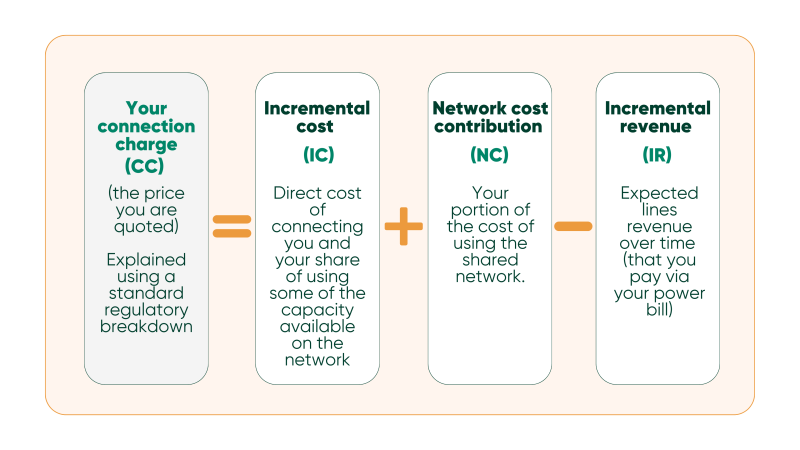
Lines companies must prepare a standardised breakdown of connection charges into:
- incremental costs (the direct cost of connecting you and your share of using some of the capacity available on the network)
- network cost contribution (your portion of the cost of using the shared network)
- incremental revenue (expected lines revenue over time - that you pay via your power bill).
This is called a ‘connection charge reconciliation.’
The reconciliation outcome shows how the connection charge compares to long-term costs and revenue using a consistent national format.
Important
This is mainly a disclosure requirement. It does not automatically change how lines companies set prices. It standardises how charges are explained and increases comparability.
What this means for you
You can request a reconciliation showing how your connection charge is allocated.
- The reconciliation is for transparency — it doesn’t change your quote or create a new charge.
- It may group costs differently from your quote, because it follows a standard format set by the Electricity Authority.
The reconciliation you receive is detailed and complex. It summarises costs, revenue and network capacity components using standardised language. This reflects the standardised format and terminology required under new regulation. If you would like help understanding it, check out our reconciliation explainer or get in touch with your lines company.
Standard connection rates (posted charges)
- If your connection uses a standard connection rate (for example, a flat charge for a typical residential connection), lines companies may provide a standard reconciliation instead of a bespoke one.
- This is permitted under the Electricity Authority’s rules and reflects the average costs and revenue for that class of connection. It ensures transparency while avoiding unnecessary modelling for routine connections.
- If your connection involves a standard connection rate, you may not receive an individualised quote.
4. Capacity costing (new approach to network upgrades)
4. Capacity costing (new approach to network upgrades)
(Mandated from 1 April 2027 for pricing, used earlier in reconciliation)
What does capacity mean?
In simple terms, capacity is the amount of electricity the network is able to carry at one time. Think of the electricity network like a system of roads:
- The wires and transformers are like roads and bridges.
- The electricity flowing through them is like traffic.
- Capacity is how wide the road is — how much traffic it can safely carry at once.
When you connect to the network or increase your load, you use some of that available capacity. If there isn’t enough spare capacity, parts of the network may need to be upgraded to handle the extra demand.
Capacity charges are about contributing fairly to the cost of making sure the network can safely carry the electricity you need — especially during busy times.
What’s changing?
If a lines company chooses to recover the cost of network capacity upgrades, it must use clear, published rates based on the cost of adding capacity. It cannot pass the full cost of an upgrade on to the customer who happens to trigger it. This reduces the risk that the final customer before an upgrade pays a disproportionately high amount.
Important
From 1 April 2026, this is only an estimated disclosure requirement. It does not automatically change how lines companies set prices. Published rates are only required from 1 April 2027. However, because of the disclosure requirement from 1 April 2026, some lines companies are choosing to early-adopt these changes to their underlying pricing.
What this means for you
- Charges for network capacity should become more predictable.
- You should not face a disproportionate charge simply because of timing.
What is not changing?
- Connection charges will still vary depending on location, size and technical requirements.
- The rules do not require all lines companies to charge the same amounts.
- Prices will still reflect the real costs of building and upgrading networks.
Why might impacts differ between regions?
New Zealand’s electricity networks differ in:
- geography
- customer density
- existing infrastructure
- historic pricing approaches.
Some lines companies may have little change to the amount they charge. Others may need to adjust how they allocate costs. This may result in some rebalancing between the cost you pay up front for the new connection, and the ongoing charge you pay as part of your power bill.
This means impacts for customers may vary depending on where you connect.
What should I do if I’m planning a connection?
- Talk to your local lines company early.
- Ask about flexible options.
- Ask for a reconciliation if you want to see how your charge is mapped to standard regulatory categories.
- Ask whether a pioneer scheme may apply.
FAQs
Are connection charges going up?
Are connection charges going up?
The new rules do not automatically increase or decrease charges for new connections. They change how charges are structured and explained.
Some customers may see changes if their lines company adjusts its pricing approach. Others may see little difference.
So, charges could stay similar, or move up or down, but it will depend on your location and circumstances.
Why are you giving me a ‘reconciliation' document?
Why are you giving me a ‘reconciliation' document?
The reconciliation is a standardised breakdown required by regulation to be provided to customers, if requested. It:
- separates direct connection costs from wider network costs
- hows how expected future network revenue relates to the charge.
While the regulations require the reconciliation to be detailed and complex, it does improve transparency and consistency across the country.
It doesn’t change your quote or create a new charge.
Why doesn’t the reconciliation look like my quote?
Why doesn’t the reconciliation look like my quote?
Your quote is designed to explain the physical work and project costs.
The reconciliation follows a regulatory format required by the Electricity Authority. It groups costs differently to allow consistent comparison across all lines companies and all connections.
For more information about understanding your reconciliation, check out our explainer.
What is ‘network capacity’ and why am I paying for it?
What is ‘network capacity’ and why am I paying for it?
Network capacity is the ability of the wider network (lines, transformers, substations) to carry electricity.
When you connect, you use some of that shared capacity. The new rules allow lines companies to allocate a share of capacity costs in a more consistent and predictable way.
What is a ‘net present value’ (NPV) calculation?
What is a ‘net present value’ (NPV) calculation?
An NPV calculation estimates the value today of money expected to be received in the future. In simple terms:
- When you connect, you will also pay ongoing network charges over time (as part of your power bill).
- The reconciliation compares the upfront charge with the expected future revenue from your connection.
- Because future money is worth less than money today, it is adjusted to a 'today value’ (or ‘net present value’).
This helps assess whether new connections are paying their ‘fair share’ overall.
You do not need to calculate this yourself — it is part of the regulatory disclosure.
More information on this disclosure within the connection charge reconciliation is found in the connection charge reconciliation explainer.
Does this mean I’m being cross-subsidised, or subsidising others?
Does this mean I’m being cross-subsidised, or subsidising others?
The rules aim to reduce unfair cross-subsidies over time. However, lines companies are shared systems. Costs are spread across many users within communities, and complete separation is not always practical or efficient.
The new rules are designed to make these cost allocations more transparent.
I’ve heard about a 'minimum scheme' — does that mean I’m getting a lower-quality connection?
I’ve heard about a 'minimum scheme' — does that mean I’m getting a lower-quality connection?
No. The minimum scheme must still meet technical and safety standards. It simply ensures you are not charged for enhancements you may not need.
You can choose higher specifications if you wish, at your cost.
What is a pioneer scheme?
What is a pioneer scheme?
If you are the first person to fund a network extension, later users who benefit from that extension may contribute to you through a formal arrangement via the lines company.
This makes the process fairer over time.
Why do connection processes differ between lines companies, and what does this mean under the new rules?
Why do connection processes differ between lines companies, and what does this mean under the new rules?
Lines companies can deliver new connections in different ways.
Some lines companies manage the entire process directly with connecting customers — including design, pricing and construction coordination.
Others use accredited third-party contractors or developers to design and build the connection assets. Once the assets meet required technical standards, they are transferred (‘vested’) into the lines company’s network.
Both approaches are established models used across New Zealand. The choice of model often reflects:
- the size and geography of the network
- the types of connections typically undertaken (for example, subdivisions vs. one-off industrial connections)
- historic contracting and delivery arrangements.
What this means for customers
The delivery model can affect:
- who you contract with for the construction work
- when detailed construction costs are provided
- how information is presented at different stages.
However, regardless of the delivery model:
- the lines company sets the technical and safety standards
- the lines company is responsible for how assets integrate into the network
- the lines company must comply with the Electricity Authority’s connection pricing rules.
What this means under the new connection pricing requirements
The new connection pricing rules apply in the same way across all lines companies.
This means that, whether your lines company works directly with you or through a contractor:
- the minimum scheme requirement still applies
- pioneer scheme requirements still apply where relevant
- a connection charge reconciliation must be available on request
- pricing must follow the required regulatory methodologies.
In third-party delivery models, you may receive:
- a construction quote from a contractor or developer, and
- a regulatory reconciliation from the lines company.
These documents serve different purposes. The construction quote explains the physical work being carried out. The reconciliation explains how the connection charge is presented under the standard regulatory framework.
If you are unsure who to contact at any stage, your lines company can explain the process and clarify responsibilities.
What the reconciliation will show if you negotiate the physical works with a third-party contractor
You will most likely find that the ‘extension cost’ and ‘connection charge’ both exclude the works contracted directly with the contractor, as the lines company does not have visibility of these charges.
I’m on a standard connection fee (for example, a flat $2,000 charge). Why haven’t I received a reconciliation specific to my connection?
I’m on a standard connection fee (for example, a flat $2,000 charge). Why haven’t I received a reconciliation specific to my connection?
If your connection falls under a ‘standard posted connection fee,’ the Electricity Authority allows lines companies to prepare a ‘standardised reconciliation’ instead of a customer-specific one.
This is because the charge is already:
- pre-set
- published
- applied consistently to a defined category of connections.
The Electricity Authority’s reconciliation requirement is about transparency and consistency. Where a standard fee applies, a standard reconciliation can meet that requirement.
What does a ‘standard reconciliation' show?
What does a ‘standard reconciliation' show?
A standard reconciliation for standard rate connection fees typically shows:
- the average incremental cost of a standard connection
- any allocation of network capacity costs
- the expected average incremental revenue over time
- how these balance on a net present value (NPV) basis.
It represents the typical cost structure for that class of connection, rather than modelling each individual household or small commercial job separately.
More information about this can be found in our connection charge reconciliation explainer.
The reconciliation is standard and complex. Does this reduce transparency?
The reconciliation is standard and complex. Does this reduce transparency?
No. The goal of the reconciliation requirement is to:
- provide a consistent breakdown format
- enable monitoring and comparison
- improve visibility of how charges relate to long-term costs.
For standard, repeatable connections (such as basic residential services), using an averaged/standard reconciliation:
- maintains transparency
- avoids unnecessary cost and complexity
- ensures consistent treatment of similar customers.
Can I request more detail about my specific connection?
Can I request more detail about my specific connection?
Yes. Even where a standard reconciliation applies, you can still:
- request a breakdown of the physical works involved in your connection
- ask questions about how the standard fee was determined.
The reconciliation is a regulatory disclosure tool — your quote and project scope remain available and explain the actual work being done.